

Why Finding an Autism Evaluation in Utah Can Be Difficult
Knowing that your child should be evaluated is only the beginning. The next challenge is finding a provider who performs the appropriate evaluation, works with your insurance or Medicaid coverage, and has appointments that fit your family’s needs.
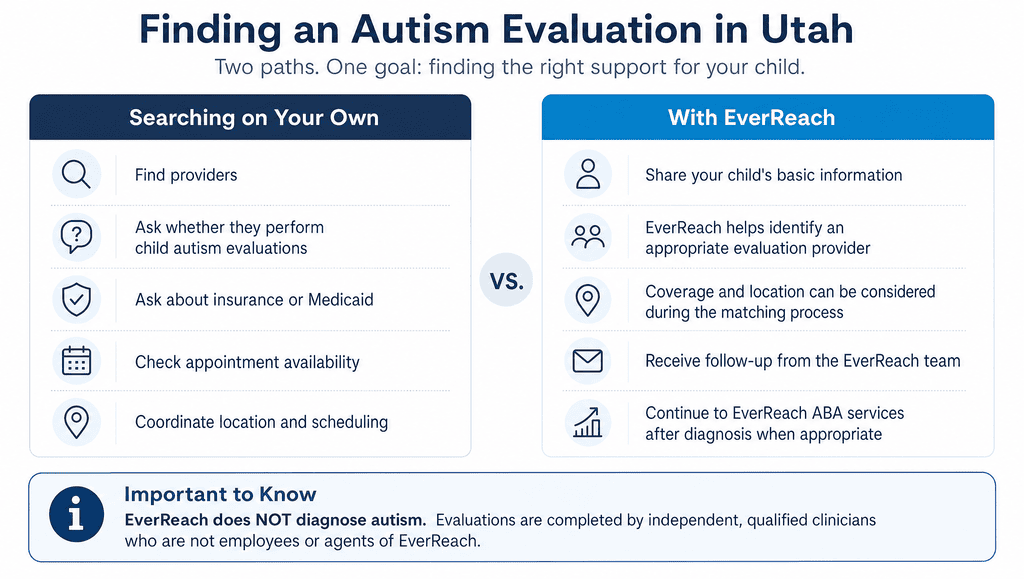
Utah Medicaid guidance explains that families can start with a pediatrician or primary care provider, who may assess the child or help connect the family with a psychologist or another qualified clinician. Families who need to find a provider independently may also need to contact multiple offices and ask about evaluation services, insurance participation, availability, location, and the evaluation process.
For many parents, the difficulty is not knowing that they need an evaluation. It is figuring out where to start and which provider is appropriate for their child’s needs.
When Should You Consider an Autism Evaluation?
There is no single sign that means a child is autistic. Parents often start looking for an autism diagnosis after noticing a pattern of differences in communication, social interaction, behavior, play, or sensory responses.
Some things that may prompt a parent to speak with a pediatrician or seek an evaluation include:
- Delays or differences in speech and communication
- Difficulty engaging socially or connecting with other children
- Strong distress when routines or familiar activities change
- Repetitive movements, behaviors, or patterns of play
- Unusual sensitivity to sounds, textures, lights, or other sensory experiences
- Differences in how a child plays, interacts, or responds compared with other children of a similar age
These signs do not, by themselves, mean that a child has autism. Children develop at different rates, and many developmental differences can have more than one explanation. An autism evaluation brings multiple sources of information together so a qualified clinician can determine whether the child meets the applicable diagnostic criteria.
You also do not need to be certain that your child is autistic before asking about an evaluation. If you have persistent concerns about your child’s development, talking with the child’s pediatrician or another qualified professional is a reasonable place to begin.
How EverReach Helps Utah Families Find an Autism Evaluation
EverReach ABA does not provide autism diagnostic evaluations. Instead, our team helps families connect with independent qualified clinicians who perform evaluations.
The goal is to make the process easier to navigate by helping families identify an evaluation provider based on practical factors such as location, insurance coverage, and availability.
Start with your family’s needs
You’ll provide basic information about your child and family, including your child’s age, location, insurance or Medicaid information, and the concerns that led you to seek an evaluation.
Get connected with an evaluation provider
EverReach reviews the information you provide and helps connect your family with an appropriate evaluation provider in its network. Availability depends on the individual provider and appointment schedule.
Complete the evaluation independently
The evaluation is conducted by the independent clinician. The clinician gathers information about your child’s development and current functioning and determines whether the child meets the applicable diagnostic criteria.
Understand what comes next
If your child receives an autism diagnosis and your family is considering ABA therapy, EverReach can help you explore the next steps for accessing ABA services.
Get connected with EverReach to tell us about your child and learn how our team can help.
How to Get Your Child Tested for Autism in Utah
If you’re wondering where to start, this short guide shows the basic path from developmental concerns to an autism evaluation and explains where a qualified evaluation provider fits into the process.
How to Get an Autism Diagnosis in Utah: Step by Step
If you are searching for how to get an autism diagnosis, the process generally starts with recognizing a concern and connecting with an appropriate healthcare professional. The exact path can vary depending on your child’s age, needs, healthcare provider, and insurance coverage.
1. Talk with your child’s pediatrician or primary care provider
Share what you have noticed about your child’s communication, social interaction, behavior, development, or daily routines. Your child’s doctor can help determine whether further evaluation is appropriate and may provide a referral.
2. Find a qualified evaluation provider
Autism evaluations can be performed by appropriately qualified professionals, including psychologists and certain physicians or other licensed clinicians with the appropriate training and scope of practice. Ask the provider what type of evaluation they perform and whether they work with your insurance or Medicaid plan.
3. Complete the evaluation
The clinician gathers information about your child’s development and current behavior. This may include parent interviews, developmental history, direct observation, and standardized assessment tools or other clinical methods appropriate to the child.
4. Review the results
The evaluating clinician explains the findings and whether the child meets the diagnostic criteria for autism spectrum disorder. The family may also receive recommendations for additional evaluations, therapies, educational supports, or other services.
5. Explore appropriate support
If your child receives an autism diagnosis, the next step is understanding which services may be appropriate and available through your insurance or Medicaid coverage. For families considering ABA therapy, EverReach can help explain the next steps for getting started with in-home ABA services.
What Happens During an Autism Evaluation?
An autism evaluation looks at the whole child rather than relying on one behavior or one short observation. The clinician considers developmental history, communication, social interaction, behavior, and other relevant information to understand how the child functions across different situations.
Depending on the provider and the child’s circumstances, an evaluation may include several components:
| Part of the evaluation | What it may involve |
|---|---|
| Developmental history | Discussion of developmental milestones, communication, behavior, and changes over time. |
| Parent interview | Your observations about communication, social interaction, routines, behavior, and daily life. |
| Communication | How your child communicates, understands language, and expresses needs. |
| Social interaction | How your child engages with adults, children, and the surrounding environment. |
| Play and behavior | How your child plays, responds to activities, handles changes, and interacts with materials. |
| Direct observation | The clinician observes your child’s behavior and interaction as part of the overall evaluation. |
The exact evaluation process varies by provider, the child’s age, and the information available. Your evaluating clinician should explain what the appointment will involve when it is scheduled.
How to Prepare for Your Child’s Autism Evaluation
You do not need to teach your child how to behave before an autism evaluation. The most useful preparation is gathering information that helps the clinician understand your child’s development and everyday experiences.
Write down what you’ve noticed
Specific examples are more useful than broad descriptions. Note what happened, approximately when you noticed it, and whether it happens consistently or only in certain situations.
Bring relevant records
If you have pediatrician records, early intervention reports, school or preschool observations, speech or occupational therapy records, or other relevant developmental information, ask the evaluation provider whether they would like to review them.
Describe strengths as well as concerns
Tell the clinician what your child enjoys, what they do well, how they communicate, and what motivates them. An evaluation should consider the child’s abilities and interests alongside areas where additional support may be needed.
Write down your questions
Bring questions about the evaluation, results, recommendations, insurance, and what happens afterward. You are an important source of information about how your child communicates and behaves outside the evaluation setting.
What Happens After an Autism Diagnosis?
An autism diagnosis can provide a clearer framework for understanding your child’s needs and deciding what support to explore next. The recommendations will depend on your child’s individual strengths, challenges, age, and circumstances.
Explore recommended services
Your evaluating clinician may recommend additional assessments, therapies, educational supports, or other services based on your child’s needs.
Look at your insurance or Medicaid options
Once you know which services have been recommended, review your coverage and provider requirements. Ask whether the provider participates in your plan and what documentation is needed before services begin.
Consider ABA therapy when appropriate
Applied behavior analysis can address skills such as communication, social interaction, daily living, learning, and behavior. If ABA is recommended for your child, EverReach provides in-home ABA services for eligible families in its Utah service area.
Learn more about ABA therapy in Utah or contact EverReach to discuss getting started.
Finding Autism Evaluation Support in Salt Lake County and Utah County
EverReach helps families in its Utah service area connect with autism evaluation providers and explore next steps after diagnosis. Families may come to us from communities including Salt Lake City, Provo, Orem, West Valley City, Sandy, Lehi, and surrounding areas.
Our Utah office is located at 10 W Broadway, 7th Floor, Salt Lake City, UT 84101.
If you are looking for an autism evaluation in Salt Lake City, an autism assessment in Utah County, or help understanding what comes after an autism diagnosis, our team can help you determine the next step.
Tell Us About Your Child
Share your child’s age, city, insurance or Medicaid plan, and what you’ve been noticing. Our team can help you understand the next step toward connecting with an autism evaluation provider.
Start Your Child’s Autism Evaluation in Utah
You do not have to figure out the autism evaluation process alone. If you have concerns about your child’s development, start by talking with your child’s pediatrician or another qualified professional. If you need help finding an evaluation provider, EverReach can help connect your family with independent qualified clinicians in its network.
Once your child has been evaluated, EverReach can also help you understand next steps for ABA therapy when appropriate.
Get Connected Today or call (801) 528-6308.
You can also email info@everreachaba.com.
Learn more about ABA therapy in Utah.
Frequently Asked Questions About Autism Evaluation and Diagnosis in Utah
How do I get my child tested for autism in Utah?
Start by discussing your concerns with your child’s pediatrician or primary care provider. They can help determine whether an autism evaluation is appropriate and may provide a referral. You can also seek an evaluation from an appropriately qualified clinician who performs autism diagnostic evaluations.
Who can diagnose autism in Utah?
Autism can be diagnosed by appropriately qualified and licensed professionals who are trained and authorized to conduct autism diagnostic evaluations. Depending on the child’s circumstances, this may include psychologists, developmental pediatricians, neurologists, or other qualified clinicians.
What happens during an autism evaluation?
The evaluation may include a developmental history, parent interview, direct observation, assessment of communication and social interaction, and standardized or other clinical assessment methods. The exact process varies by provider and child.
Does Utah Medicaid cover autism-related services?
Utah Medicaid provides autism-related services for eligible members who meet applicable requirements. Coverage depends on the member’s eligibility, the service, provider participation, and other Medicaid requirements. Families should confirm coverage and provider participation before beginning services.
At what age can a child be diagnosed with autism?
Autism can sometimes be identified in early childhood, but the appropriate timing of an evaluation depends on the child’s development and circumstances. If you have concerns, you do not need to wait for your child to reach a particular age before discussing them with a qualified professional.
Related Reading
- ABA Therapy in Utah
- How to Start ABA Therapy in Utah
- Medicaid and In-Home ABA Therapy in Utah
- The Role of ABA Therapy in Improving Communication at Home
- What to Expect During Your Child’s First In-Home ABA Session
Medical information disclaimer: This article provides general educational information and is not medical advice. Autism evaluations and diagnoses are provided by independent qualified clinicians. EverReach ABA does not provide autism diagnostic services and helps families connect with evaluation providers and explore appropriate support after diagnosis.






 Website by

